
Spider Silk Mechanics
Spider silk fibers are protein materials with exceptional mechanical performance, including high stiffness, high tensile strength, and remarkable toughness. In addition, exposure of these silk fibers to high humidity results in supercontraction (a shortening of up to 60% in length) and twist. Our research focuses on the fundamental mechanics that govern these counter-intuitive behaviors throughthe derivation of physics-based models. The findings from our works provide insights that motivate the design of next-generation biomimetic materials.
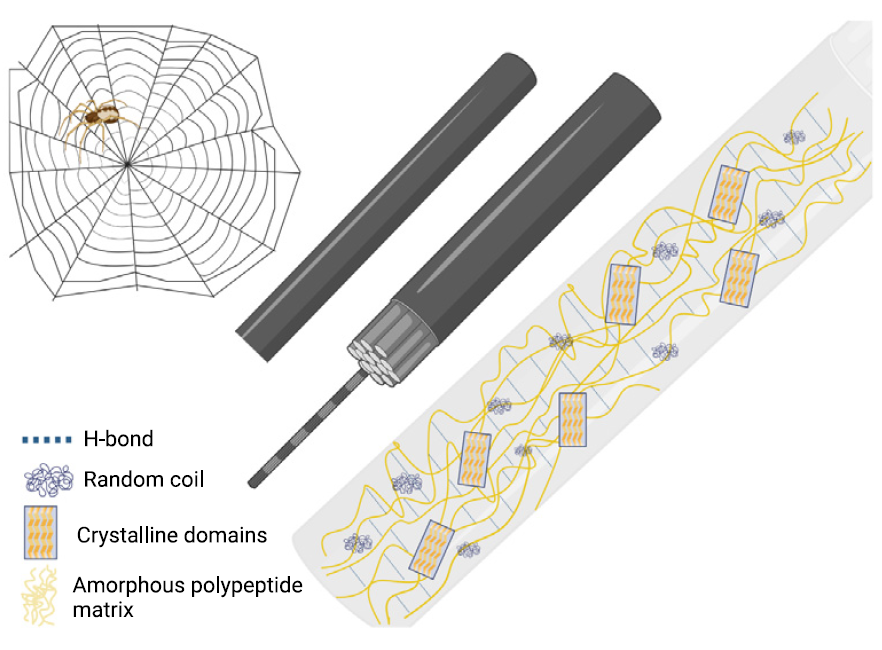
The hierarchical structure of spider silk
The mechanical versatility of spider silk is rooted in its hierarchical, semi-crystalline morphology. It consists of stiff β-sheets embedded within a disordered amorphous matrix comprising polypeptide chains that interact with each other through intermolecular hydrogen bonds. The bonds play a crucial role in the mechanical and humidity-induced response of spider silk fibers.
Water-Driven Response: Supercontraction & Twist
Spider silk exhibits a unique ability to undergo supercontraction, or a shortening of up to ~60% in response to water uptake, and twist when exposed to water or high humidity.
When hydrated, intermolecular hydrogen bonds break due to the interaction with the water molecules. As a result, the polypeptide chains gain mobility, triggering a shortening of the fiber by up to 60%. This phenomenon is commonly known as supercontraction. In addition, the fiber also experiences twist.
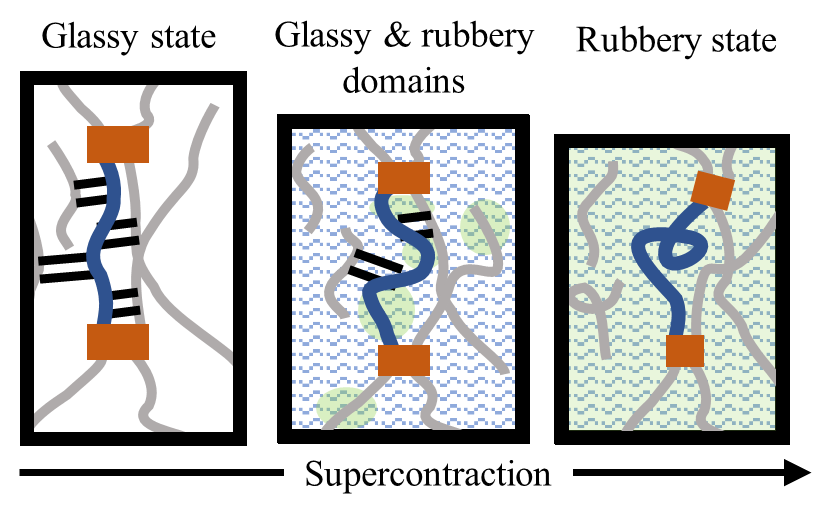
Mechanism of water-induced supercontraction
Our models explain these behaviors through the derivation of an energy-based model that relies on principals from polymer physics. The model considers the dissotion of intermolecular bonds and the consequent entropic relaxation of the chains.
Deformation mechanisms and plasticity
One of the most exciting aspects of spider silk is its high stiffness, strength, and toughness, which stem from a unique mircostructure. Recent works also show that silk fibers exhibit plasticity and hysteresis when subjected to cyclic loading. Our group developed a microscopically motivated model that reveals the underlying mechanisms behind the mechanical response of silk fibers.
The governing deformation mechanisms are as follows:
- Initial Stiffness: Governed by intramolecular hydrogen bonds.
- Yield Threshold: Determined by the density and the dissociation energy of hydrogen bonds.
- Softening: Breaking of intramolecular β-sheets along the chains and/or the crystalline domains provide additional chain length.
- Stiffening: Dominated by the entropic elasticity of the chains.
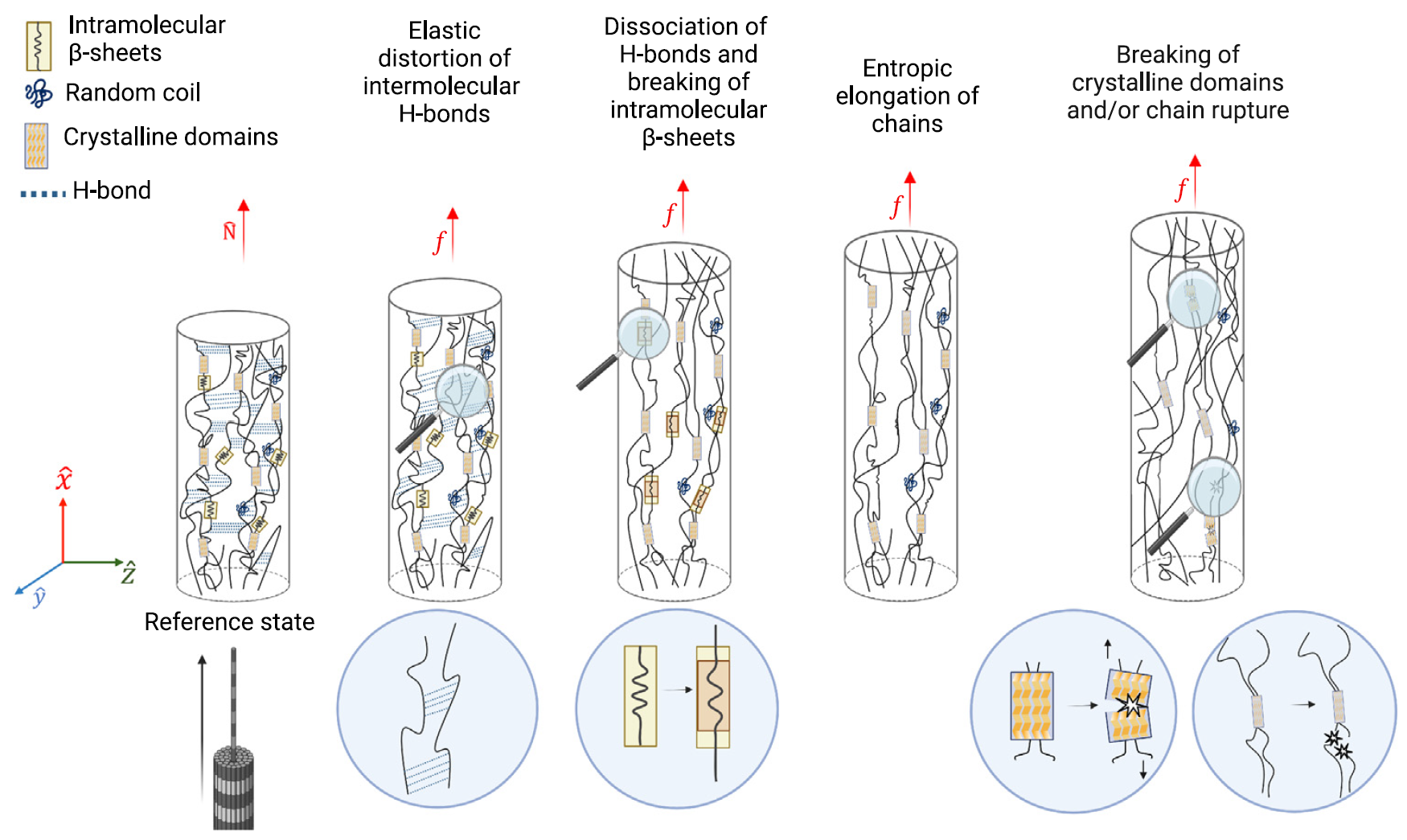
The microstructural evolution of a spider silk fiber under uniaxial extension
In our recent works we employ statistical mechanics methodology to better understand the key microstructural quantities that govern the mechanical response. The findings from our work are three-fold: (1) explaining the mechanisms that govern deformation, hysteresis, and recovery and linking them to the microstructural evolution; (2) quantifying the recovery process of the fiber, which restores and enhances mechanical properties; and (3) establishing a predictive foundation for engineering synthetic fibers with customized properties.
Relevant Publications
- Plasticity, hysteresis, and recovery mechanisms in spider silk fibers (2026)
- Modeling of protein networks reveals factors affecting stiffness, yield stress, and strain stiffening in silk fibers (2025)
- Employing spinning conditions to control the mechanical response of spider silk fibers (2025)
- Deformation and failure mechanisms in spider silk fibers (2024)
- The underlying mechanisms behind the hydration-induced and mechanical response of spider silk (2023)
- Humidity-driven supercontraction and twist in spider silk (2022)
- On the origin of supercontraction in spider silk (2021)
Detailed list of papers or a link back to the Publications page.