
Mechanics of Gels
Our group aims to provide fundamental understanding for the governing mechanisms behind the swelling and the mechanical response of polymer networks. By bridging the gap between molecular architecture and macroscopic response, our predictive models pave the way for the design of new materials with target properties.
Thermo-responsive polymers: PNIPAM
Poly(N-isopropylacrylamide) (PNIPAM) is a thermo-responsive polymer that is characterized by a Lower Critical Solution Temperature (LCST). When heated above approximately ~32°C, PNIPAM undergoes a reversible phase transition from a hydrophilic, swollen state to a hydrophobic, collapsed state. This transition is rooted in the competitive balance between the entropy of mixing and the enthalpy of hydrogen bonding between the polymer and the solvent.
In our recent works, we developed a microscopically motivated model that reveals the relations between the microstructure and the overall response. In addition, we show that external loads can trigger phase coexistence at temperatures near the LCST. By integrating Flory-Huggins theory with non-linear elasticity, our models predict how mechanical constraints can effectively "tune" the thermal sensitivity of PNIPAM.
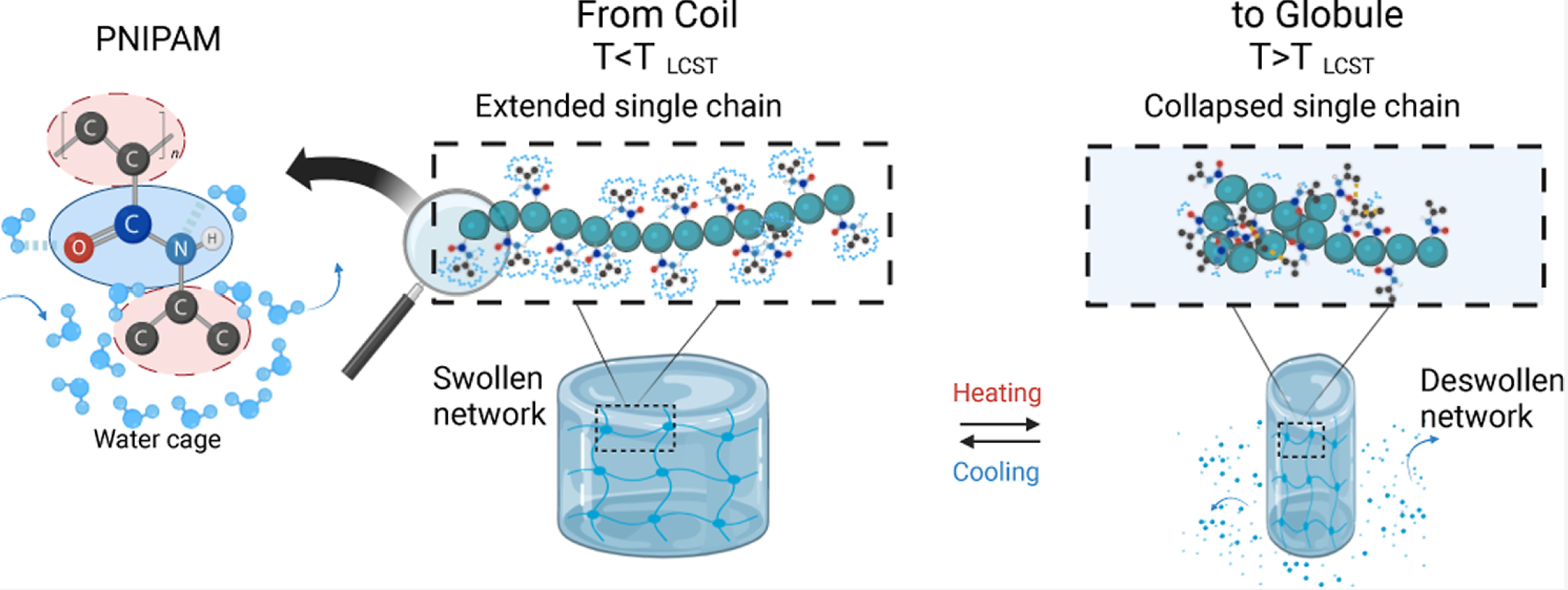
Thermally induced phase transitions in responsive gels
This intersection of thermodynamics and mechanics allows for the design of sensors and actuators that respond to both thermal and physical inputs.
The mechanics of PEGDA hydrogel networks
Thanks to many promising properties, including biocompatibility and the ability to experience large deformations, poly(ethylene glycol) diacrylate (PEGDA) hydrogels are excellent candidate materials for a wide range of applications. Interestingly, the polymerization of PEGDA leads to a network microstructure that is fundamentally different from that of the “classic” polymeric gels. Specifically, PEGDA hydrogels comprise PEG chains that are interconnected by multifunctional densely grafted rod-like polyacrylates (PAs), which serve as cross-linkers.
In our recent work, we derive a microstructurally motivated model that captures the essential features which enable deformation in PEGDA hydrogels: (1) entropic elasticity of PEG chains, (2) deformation of PA rods, and (3) PA–PA interactions. The findings from this work pave the way to the efficient design of PEGDA hydrogels with tunable properties and behaviors, which will enable the optimization of their performance in various applications.
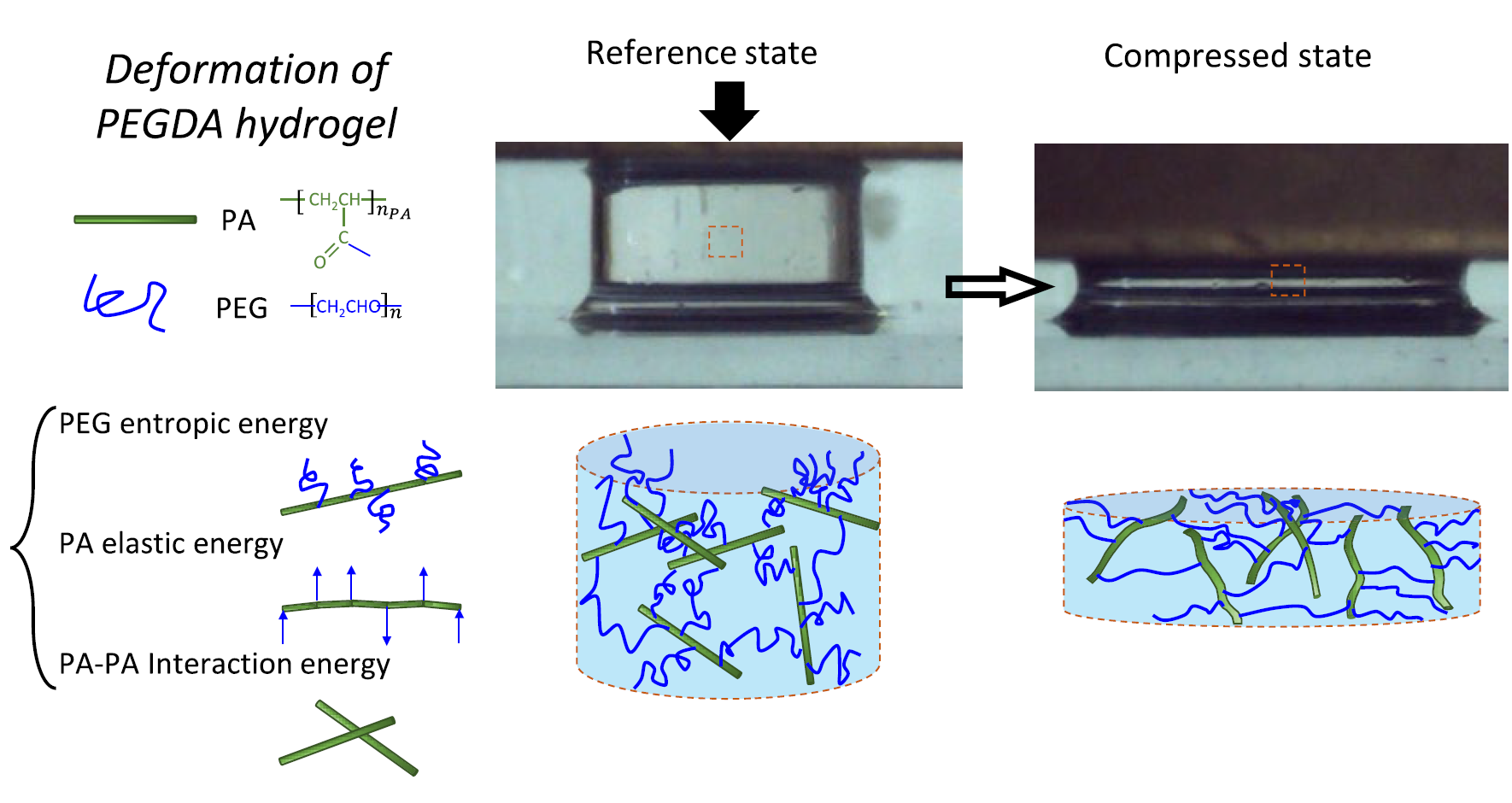
Mechanical response of PEGDA hydrogels
Relevant Publications
- Phase Coexistence in Thermoresponsive PNIPAM Hydrogels Triggered by Mechanical Forces (2026)
- Thermo-Mechanics of PNIPAM Gels: from a Single Chain to a Network Response (2025)
- Data-Driven Framework for the Prediction of PEGDA Hydrogel Mechanics (2025)
- Understanding the Response of Poly(ethylene glycol) diacrylate (PEGDA) Hydrogel Networks: A Statistical Mechanics-Based Framework (2024)
Detailed list of papers or a link back to the Publications page.