
3D-Printed Composite Structures & Actuators
Stimuli-responsive actuators respond to external cues such as water uptake, thermal excitation, and electric fields to perform mechanical work. A primary goal of our research is to utilize the fundamental principles of polymer mechanics to design stimuli-responsive actuators.
Swelling-Based Actuators and Sensors
In a recent work, we propose a design for an autonomous actuator that can perform mechanical work in response to hydration. As opposed to the classic swelling-based actuators, the proposed design includes two components: a soft active (responsive) gel that undergoes significant volumetric expansion upon swelling and a non-responsive structural element 3D-printed elastic rod.
In the proposed design, only the active gel component needs to be immersed in water to trigger swelling, while the stiff non-responsive rod serves as the load-bearing element. The actuator design is easily fabricated by leveraging the flexibility achieved by 3D-printing. The actuator lifts up to 50 g, over 40% of its own weight, without external power.
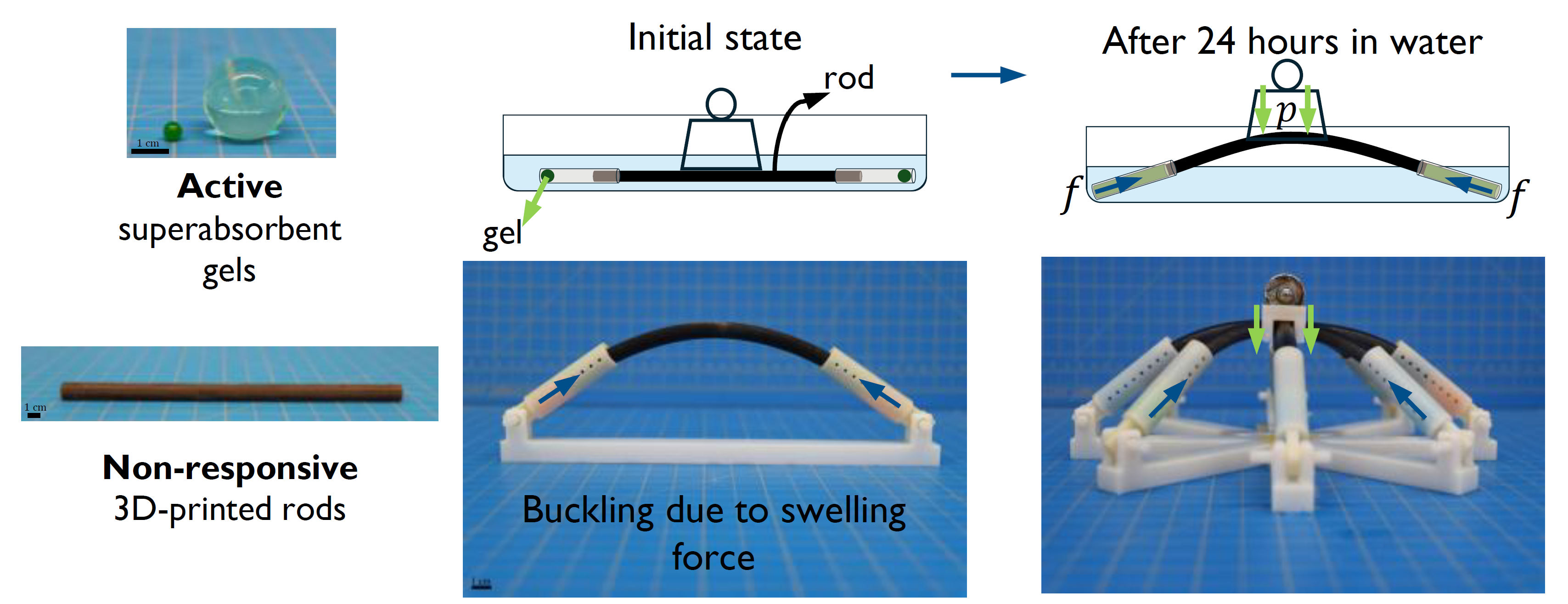
Swelling-induced actuation to perform mechanical work
This research has direct applications in the development of autonomous sensors that operate without external power, utilizing environmental humidity to trigger mechanical responses.
Thermally activated structures
Morphing structures can change their shape in response to thermal excitation and are commonly used to enhance the performance of actuators, soft robotics, and biomedical devices. One of the main challenges is the inverse design problem, in which a deformed target shape is prescribed and the initial material properties, distribution, and geometry are to be determined.
To tackle this challenge, our group developed a model for the thermo-mechanical response of multi-layered struts that experience moderate to large deflections. The model was validated through thermally activated 3D-printed bi-layer beams. The simplicity and robustness of our model reveals fundamental principle guidelines for inverse design of thermally activated shape morphing structures and enables its extension to other stimuli.
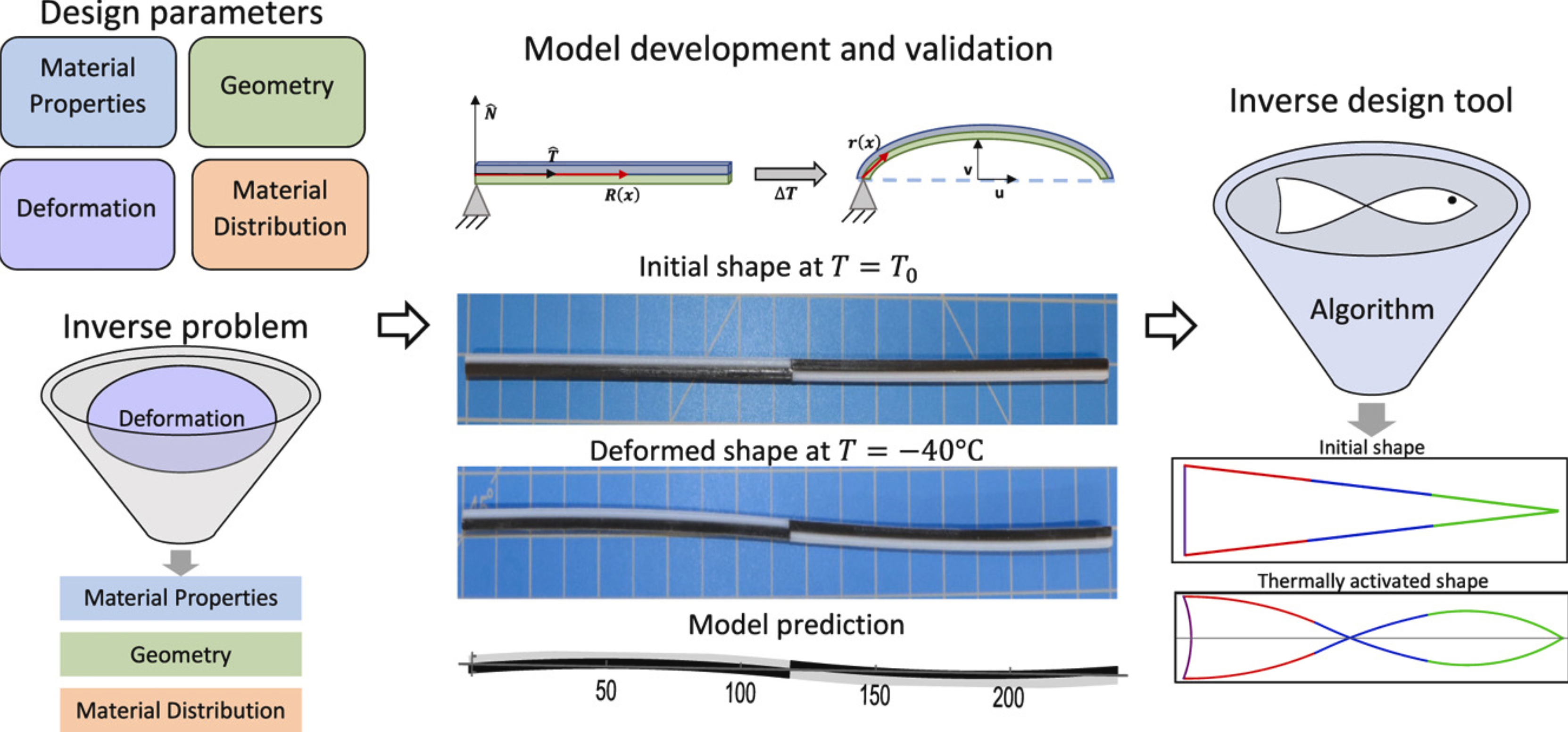
Thermal activation of morphing structures
Through the integration of analytical models and 3D-printing, we are establishing a design pipeline for adaptive materials that can sense, react, and adapt to their surroundings in real-time.
Relevant Publications
- Autonomous lifting: Swelling-activated 3D-printed actuators (2025)
- Harnessing springs to tune thermally induced snap-through instabilities in bi-layer beams (2025)
- Thermally activated tunable auxeticity in periodic lattice structures (2025)
- Design principles for 3D-printed thermally activated shape-morphing structures (2024)
- Swelling under Constraints: Exploiting 3D-Printing to Optimize the Performance of Gel-Based Devices (2023)
- Thermally induced deformations in multi-layered polymeric struts (2022)
Detailed list of papers or a link back to the Publications page.